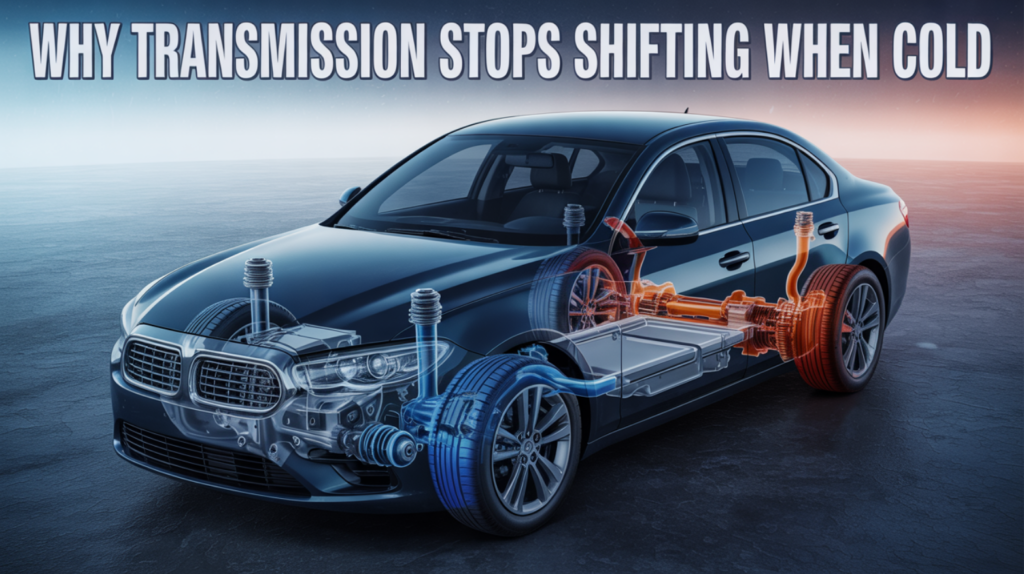
Cold weather has a quiet but powerful influence on how a transmission behaves. Many drivers first notice the problem on winter mornings when the vehicle hesitates, refuses to upshift, or feels sluggish for the first few minutes of driving. This is not coincidence. It is the transmission reacting to temperature changes inside its most sensitive systems.
For a deeper explanation of how different driving conditions affect shifting behavior, see our main guide on
Why Transmissions Stop Shifting Under Certain Conditions.
How Cold Temperatures Disrupt Transmission Operation
Transmission fluid thickens when exposed to cold. Thick fluid flows more slowly through internal passages, reducing the pressure needed to engage clutches and shift gears smoothly. At the same time, metal components contract slightly, changing clearances inside the transmission.
As these changes occur together, the control system receives delayed or inconsistent pressure signals. The result is hesitation, rough shifts, or complete refusal to shift until the transmission begins to warm.
Drivers often describe this sensation as if the vehicle is “stuck” in one gear. In reality, the system is struggling to build the pressure needed to move the gear train.
Why the Problem Improves After Warming Up
As the vehicle runs, heat generated by the engine and friction warms the transmission fluid. Warmer fluid flows freely again. Internal pressures stabilize. Clearances return closer to their intended tolerances.
This is why many cold-related shifting problems fade after several minutes of driving. The improvement is not magic. It is simply the mechanical system returning to a stable operating range.
However, repeated cold stress slowly accelerates wear. Over time, seals harden, fluid degrades faster, and sensors become more sensitive to temperature swings.
This same temperature stress also explains why transmissions sometimes behave unpredictably when hot, especially after long drives in summer.
The Role of Fluid Condition
Old or contaminated fluid amplifies cold-weather problems. As fluid ages, it loses its ability to maintain consistent viscosity across temperature changes. When winter arrives, that weakened fluid thickens excessively, worsening pressure delays and shift hesitation.
Drivers who experience cold shifting problems often also report that the transmission later begins acting strangely after extended trips, once heat finally breaks down the remaining fluid stability.
In both cases, fluid condition sits at the center of the problem.
Why Ignoring Cold Shifting Causes Bigger Failures
Cold shifting problems rarely stay small. Each cold start places additional stress on clutches, bands, and valve bodies. Over months or years, this repeated strain shortens component life and increases the risk of complete transmission failure.
When the problem is ignored, the transmission adapts in unhealthy ways. Shift timing becomes inconsistent. Gear engagement grows harsher. Eventually, internal wear reaches a point where the transmission stops shifting even under normal temperatures.
How to Reduce Cold-Related Shifting Problems
Drivers can greatly reduce cold shifting damage by allowing a brief warm-up period before driving, keeping fluid clean and properly filled, and avoiding hard acceleration while the system is cold.
These simple habits stabilize internal pressure early and prevent unnecessary wear.
Final Understanding
Cold weather places direct mechanical stress on transmission systems by thickening fluid, altering internal clearances, and disrupting pressure signals. When those changes exceed the transmission’s ability to compensate, shifting stops or loses its ability to shift consistently.
Addressing cold-weather shifting issues early often prevents years of accelerated internal wear caused by repeated winter stress.