Braking seems like the calm part of driving, yet it places the transmission in one of its most delicate balancing acts. As the vehicle slows, engine load drops, torque direction changes, and the transmission must quickly reorganize its internal pressure and gear selection.
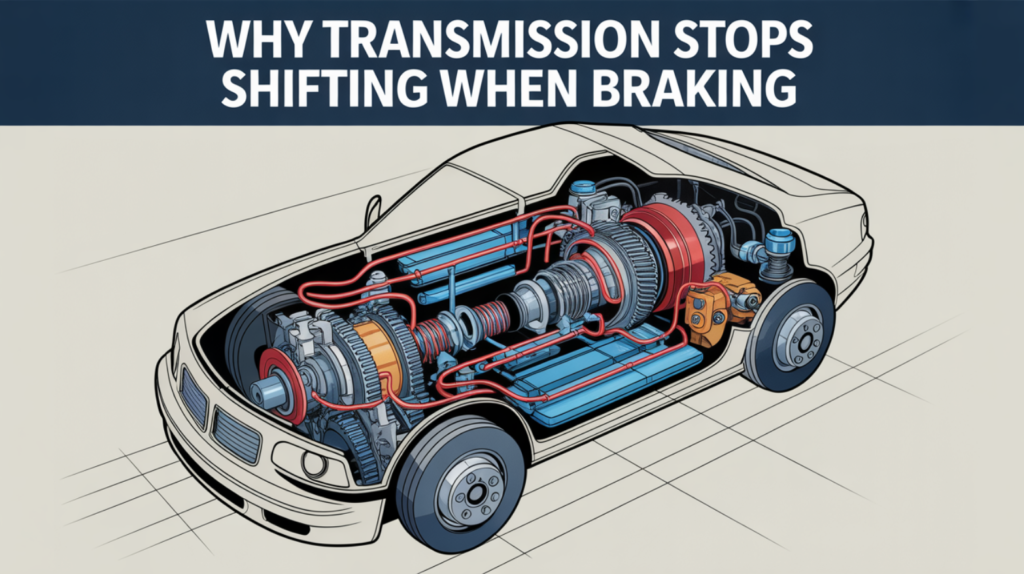
When that balance fails, shifting can hesitate, stumble, or stop altogether.
If you want the full diagnostic picture of how different driving situations influence this behavior, the main transmission conditions guide explains the broader pattern in depth:
how shifting problems develop under specific conditions.
What Changes Inside the Transmission During Braking
When the brakes are applied, engine speed decreases while vehicle momentum continues. The transmission must smoothly downshift to match this change. That process requires precise pressure control and accurate sensor feedback.
If fluid pressure is unstable or internal wear has weakened the control system, the transmission hesitates. Drivers feel this as delayed downshifts, harsh engagement, or refusal to change gears while slowing.
This sensation often feels worse in traffic, where repeated braking and accelerating amplify internal stress.
Why Braking Problems Often Appear With Other Symptoms
Braking-related shifting issues rarely occur alone. Many drivers who experience hesitation while slowing later report that the transmission also misbehaves during turns, because both situations involve rapid changes in load and torque direction.
Others notice that the problem becomes more obvious while waiting at traffic lights, when internal pressure and cooling are at their lowest.
The Hidden Role of Heat and Fluid Condition
Braking itself does not create heat, but it often follows periods of acceleration and load. That accumulated heat weakens fluid performance. When degraded fluid cannot hold stable pressure, the transmission struggles to manage downshifts smoothly.
Over time, this pattern accelerates wear on clutches and valves, making shifting increasingly unpredictable.
Why Ignoring Braking Symptoms Leads to Bigger Failures
Shifting problems during braking place repeated stress on internal components. Each rough or delayed downshift erodes the system’s ability to maintain precise control. Eventually, the transmission begins misbehaving in more driving situations, not just while slowing.
How to Reduce Braking-Related Shifting Issues
Smooth driving habits, proper fluid maintenance, and early diagnosis of pressure or sensor problems significantly reduce braking-related stress. These steps stabilize internal operation and extend transmission life.
Final Understanding
Braking forces the transmission to rebalance torque, pressure, and gear selection in seconds. When that balance cannot be maintained, shifting no longer responds smoothly to load changes.
Downshift instability during braking tends to spread quickly into broader shift failures if left unresolved.