Torque plays a far more important role in towing and off-road driving than horsepower does. When the vehicle needs to move heavy weight, climb uneven surfaces, or push through resistance, the engine’s twisting force becomes the deciding factor in whether the vehicle feels effortless or strained. Understanding how torque behaves in low-speed environments helps you choose the right engine for trailers, hills, mud, sand, and rugged terrain.
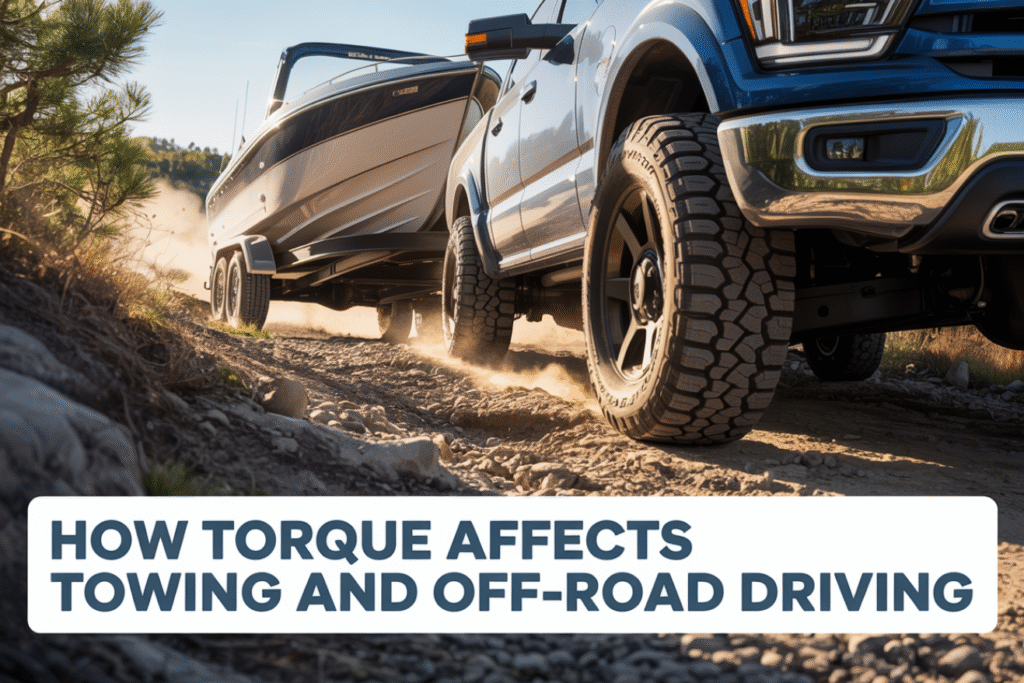
Why torque is the foundation of towing and off-road performance
Torque is the twisting force that rotates the crankshaft, moves the drivetrain, and applies force to the wheels.
When a vehicle pulls a trailer or climbs an obstacle, the wheels must overcome gravity, rolling resistance, and terrain friction. This demand requires strong, low-RPM torque because the force must be available before speed builds.
Horsepower influences how fast a vehicle can accelerate once it is already moving, but towing and off-road conditions rarely involve high speed. Instead, they rely on immediate force delivered at low engine speeds. This is where torque becomes the leading factor.
Why low-RPM torque matters most
Towing or climbing often begins from a standstill or low crawl speed. The vehicle needs usable torque without requiring high RPM. Engines that produce high torque at 1,500–2,500 RPM provide immediate, controlled movement, while engines that only make torque at higher RPM feel stressed and require more throttle.
This is the reason diesel engines and turbocharged petrol engines are preferred for towing: they produce strong torque early, allowing smooth, confident movement without revving hard.
Torque, gearing, and wheel force
Wheel torque is what truly moves the vehicle, and it depends on engine torque multiplied by the drivetrain:
- Lower gears increase wheel torque
- Higher gears reduce torque multiplication
In towing mode or low-range off-road mode, the transmission selects or provides the lowest gear possible to maximize torque at the wheels. This mechanical advantage allows the vehicle to pull trailers up inclines, crawl over large rocks, or push through deep sand with minimal strain.
Without adequate wheel torque, even a powerful engine can struggle because the force reaching the tyres is not enough to overcome the terrain.
How torque influences towing performance
Starting with a heavy trailer
Strong torque at low RPM lets the vehicle begin moving without hesitation. A weak-torque engine will require more throttle input, create more heat, and strain the transmission.
Accelerating with a load
Once the trailer is moving, the drivetrain must maintain enough torque to keep the weight stable. Engines with narrow torque curves force the transmission to hunt between gears, while engines with broad torque bands maintain momentum more easily.
Climbing hills with a trailer
Inclines demand extra force. An engine with a flat, strong torque curve climbs steadily without constant downshifting. Engines that rely mostly on horsepower need higher RPM to perform the same task, which feels less controlled and more stressful on the drivetrain.
Maintaining control and stability
Towing requires smooth, predictable force. Abrupt power delivery can unsettle the trailer. Engines that provide steady torque across the mid-range maintain stable speed and reduce unnecessary gear changes.
How torque influences off-road driving
Rock crawling and steep inclines
At low speeds, traction is limited and momentum drops. Torque becomes the only way to keep the vehicle moving under control. Low-range four-wheel-drive mode increases torque multiplication, letting the tyres grip and climb without wheelspin.
Mud, snow, and sand
These surfaces increase resistance. The tyres must push through loose material, which demands high wheel torque at low RPM. Too little torque causes bogging; too much RPM causes wheelspin. Engines with smooth torque delivery maintain traction more effectively.
Descending hills with engine braking
Strong low-end torque is linked with strong engine braking. When descending, a torquey engine holds speed in control without relying entirely on the brakes, reducing heat buildup and increasing safety.
Recovery situations
Pulling another vehicle out of mud or extracting your own requires immediate force rather than high-rev power. Torque gives the vehicle the ability to perform these recoveries without sending the engine into stressful high-RPM bursts.
Why diesels, turbo engines, and EVs excel off-road
Diesel engines
Diesels generate high torque at extremely low RPM, often below 2,000. This gives them exceptional pulling strength, ideal for steep climbs and heavy trailers.
Turbo petrol engines
Modern turbo engines produce more torque earlier than naturally aspirated engines, making them capable in both towing and light off-roading.
Electric motors
EVs deliver maximum torque from zero RPM. This instant force allows precise low-speed control and strong climbing ability. With proper cooling and drivetrain design, electric off-road vehicles perform impressively in crawling and sand environments.
What to check when choosing a vehicle for towing or off-road use
- Peak torque number (higher is generally better)
- RPM where torque arrives (lower RPM = better control)
- Width of the torque curve (broad curve = stable performance)
- Gear ratios and low-range availability
- Vehicle weight and cooling system capacity
- Towing capacity and drivetrain strength
- Tyre grip and terrain management modes
A vehicle can have high horsepower and still perform poorly in towing if its torque arrives too late. Likewise, a moderately powered diesel can outperform a high-horsepower petrol engine in off-road climbing thanks to stronger early torque.
Final takeaway
Towing and off-road driving rely heavily on torque because the vehicle must deliver strong, controlled force at low speeds. Torque determines how easily the vehicle pulls weight, climbs obstacles, maintains stability, and pushes through difficult surfaces. Horsepower still matters, but its influence appears more at higher speeds where towing and off-roading rarely operate.
When evaluating a vehicle for hauling or rugged terrain, focus first on low-RPM torque, the width of the torque curve, and the gearing that multiplies this force. Once you understand these elements, selecting the right engine for real-world strength becomes straightforward.