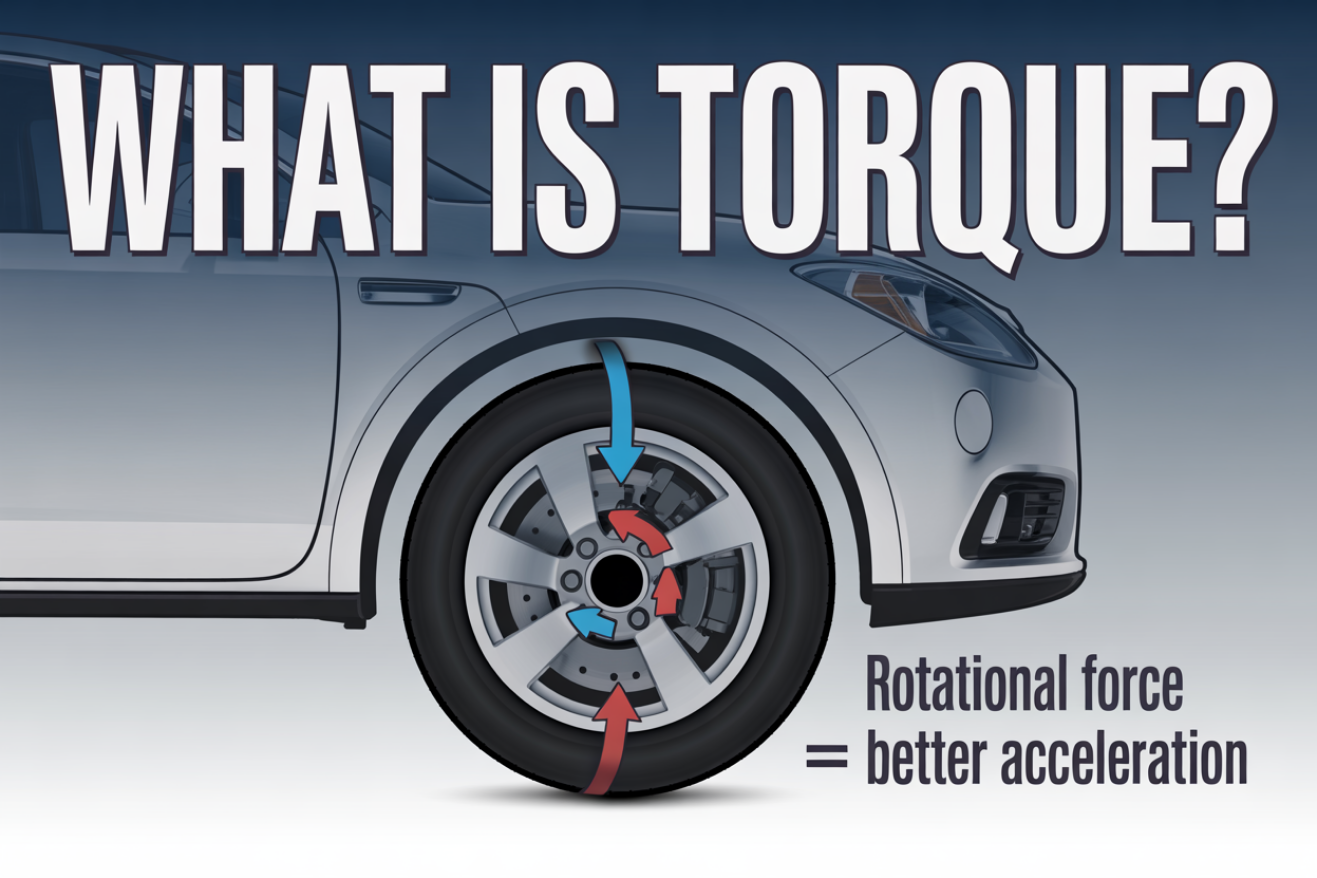
Torque is the twisting force that makes your car’s wheels turn. The more torque an engine can deliver at low and mid RPM, the stronger the car feels when you pull away, merge into traffic, climb a hill, or tow a load. If you want to explore related topics step by step, you can browse all articles in the Torque Guides section.
What torque actually is
If you remember just one thing, make it this:
Torque is the force that twists the engine and turns the wheels.
Horsepower is how fast the engine can keep delivering that work.
Torque is the “push” you feel first. Horsepower is how strongly the car keeps pulling as speed rises.
If you want a deeper comparison, the dedicated torque vs horsepower guide explains both in detail.
Torque vs force: the easy way to picture it
Imagine trying to loosen a tight bolt:
- You use a wrench.
- The longer the wrench, the easier it is.
- The more force you apply at the end, the more twisting force you create.
That twisting force is torque.
In a car:
- The crankshaft is the bolt.
- The pistons and rods are your hand pushing.
- The gear ratios act like a “longer” or “shorter” wrench.
More torque at the wheels means the car moves more easily, especially from a stop or under load.
How torque, RPM and gearing work together
Engines don’t produce the same torque everywhere. Torque changes with RPM, and gearing multiplies that torque differently in each gear.
Three things matter:
- Engine torque – how much twisting force the engine makes at a given RPM.
- RPM – how fast the engine spins while producing that force.
- Gear ratios – how much torque multiplication happens before it reaches the wheels.
Lower gears multiply torque more, so the car feels stronger at low speed.
Higher gears multiply torque less, so they feel weaker but allow efficient cruising.
Even a modest engine can feel strong in the right gear thanks to torque multiplication. The torque ⇄ horsepower calculator shows exactly how torque and RPM interact, and the dedicated gear ratio torque guide explains in detail how gearing multiplies torque at the wheels.
How torque feels in everyday driving
City driving
Cars with strong low-RPM torque feel smooth and effortless at low speeds. You barely press the pedal and the car moves without strain. Cars with weak torque require more throttle or downshifts.
Highway merging and passing
When you accelerate to merge or overtake, the transmission often downshifts to put the engine in its best torque range. Engines with a broad torque band feel responsive without needing much revving.
Climbing hills
Strong mid-range torque makes hills feel easy. Cars with limited torque need to downshift more often to maintain speed.
Towing and heavy loads
Torque matters most here. Engines that produce high torque at low RPM—like turbo diesels or modern small turbo petrol engines—handle towing with less stress.
You can read more in the <a href=”/guides/torque-for-towing-and-off-road/”>towing and off-road torque guide</a>.
Why some engines feel “torquey” and others don’t
Two engines may have the same horsepower yet feel completely different.
Engines with a broad torque curve
These have:
- Strong torque across a wide RPM range
- Smooth response in daily driving
- Less need for downshifts
This makes them feel confident and flexible.
High-revving, “peaky” engines
These engines:
- Have less torque at low RPM
- Only feel alive when revved
- Require more downshifts
Exciting at high RPM, but not always practical for everyday use.
Turbo, diesel, and EV torque
- Turbo petrol engines often make high torque early, which improves drivability.
- Diesels produce strong torque at very low RPM, perfect for towing and long-distance driving.
- EVs deliver instant torque from zero RPM, which is why they feel so quick from a standstill.
The full comparison is covered in the <a href=”/comparisons/ev-vs-petrol-torque/”>EV vs petrol torque</a> guide.
How to read torque numbers on a brochure
A typical spec might say:
320 Nm @ 1,800–4,000 RPM
This means:
- 320 Nm is the peak torque.
- It is available between 1,800 and 4,000 RPM.
A wider torque band usually means easier everyday drivability. Peak torque at low RPM is great for towing and relaxed driving. Peak torque high in the rpm range creates a sporty high-rev character.
What brochures don’t show is wheel torque, which depends heavily on gear ratios. That’s why two cars with the same engine can feel different if one has shorter gearing.
Quick questions about torque
Does more torque always mean faster?
Not alone. Speed depends on torque, horsepower, gearing, weight, traction, and aerodynamics. The dedicated <a href=”/guides/torque-acceleration/”>torque and acceleration guide</a> shows how these factors combine for 0–60 times and real-world performance.
Is torque more important than horsepower?
It depends on what you do:
- Towing, hauling, off-road → torque matters more
- High-speed acceleration → horsepower matters more
The full answer is in the <a href=”/guides/torque-vs-horsepower/”>horsepower comparison article</a>.
Why do EVs feel faster than their power numbers?
Because they deliver maximum torque instantly at zero RPM.
How can you understand your own car’s torque?
- Look at the torque number on the spec sheet.
- Notice the RPM range where the car feels strongest.
- Use a calculator to see how torque and RPM convert into horsepower.
Final takeaway
Torque is the force that lets a car:
- Pull strongly from low speeds
- Climb hills without struggle
- Accelerate confidently
- Tow and haul effectively
To understand any car’s performance, ask:
- How much torque does it make?
- Where in the RPM range is that torque available?
- How do the gear ratios use that torque on the road?
Once you start thinking this way, torque numbers turn into real-world expectations—and every car review becomes easier to understand.