A transmission pump noise that appears only when accelerating uphill, yet disappears on flat roads, is a classic contrast symptom. It tells you the problem isn’t raw speed or RPM, it’s the combination of vehicle angle and added load. When those two line up, small hydraulic weaknesses stop hiding and become audible.
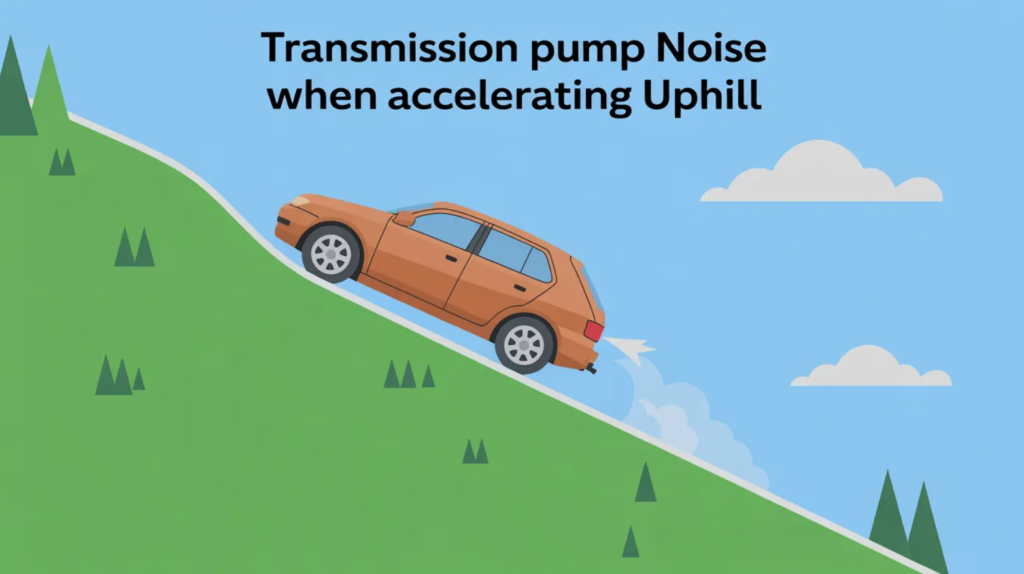
This pattern fits within the broader behavior explained in transmission pump noise under load, but the uphill-only detail sharply narrows the cause list.
How urgent is this symptom?
- Low urgency: the noise is brief, mild, and doesn’t change shift feel.
- Moderate urgency: the noise grows louder the steeper the hill, or you feel softer engagement under throttle.
- High urgency: slipping, flare, delayed response, or a burnt smell after hill climbs, stop stressing the drivetrain until diagnosed.
Because hills combine load and angle, unresolved issues tend to worsen faster than flat-road problems.
Why hills expose the noise (what’s different)
Accelerating uphill changes three things at once:
- Load increases: more torque is required to maintain speed.
- Fluid shifts in the pan: the pickup can become partially uncovered if the level is marginal.
- Demand lasts longer: you stay in the “high demand” state for several seconds, not just a moment.
Flat-road acceleration lacks the angle component, which is why the noise may never appear there.
What the contrast tells you immediately
This is one of the clearest “what it is vs what it isn’t” scenarios:
- If it were pure pump wear, you’d usually hear it in many conditions.
- If it were wheel or driveline noise, road angle wouldn’t matter.
- If it were exhaust or engine accessory noise, throttle position alone would trigger it anywhere.
An uphill-only pump noise almost always points toward fluid level, pickup exposure, aeration, or restriction, sometimes made worse by heat.
Most likely causes (ranked for uphill-only acceleration)
1) Fluid level just low enough to uncover the pickup on an incline
Mechanism: As the vehicle noses up, fluid moves toward the back of the pan. Under acceleration, demand rises. If the pickup is partially uncovered, the pump draws air and whines.
Why flat roads are quiet: the pickup stays submerged when the vehicle is level.
2) Aeration from a marginal pickup seal or suction-side leak
Mechanism: Even without fluid leaking out, a compromised seal can allow air in. The uphill angle and higher demand make that leak audible.
Clue: the noise may change sharply with hill steepness rather than speed.
3) Restricted filter that can’t keep up under combined angle + load
Mechanism: A partially clogged filter increases inlet vacuum. Add an incline and sustained throttle, and cavitation becomes likely.
Clue: the noise is worse on longer hills and improves quickly on level ground.
4) Heat buildup during climbs
Mechanism: Hills generate heat quickly. Hotter, thinner fluid increases internal leakage, forcing the pump to work harder to maintain pressure.
Clue: the noise is more pronounced late in the drive or on warm days.
5) Pressure regulation instability under sustained uphill load
Mechanism: Holding a steady but elevated pressure command can cause worn regulator valves to resonate.
Clue: the noise has a smooth, steady tone rather than a rough growl.
Simple uphill-specific tests that actually help
Try the same hill at two different throttle levels
Why: separates load from angle.
Result:
- Noise appears only with more throttle: load-related supply or regulation issue.
- Noise appears regardless of throttle once uphill: fluid level/pickup exposure moves up the list.
Compare uphill vs downhill acceleration
Why: downhill keeps demand but reverses fluid movement in the pan.
Result:
- Noise uphill only: strong evidence of pickup exposure or aeration.
- Noise both ways: broader pressure or pump issue.
Re-test with a warm transmission
Why: heat amplifies supply and restriction problems.
Result: louder or longer-lasting noise when warm supports restriction, aeration, or cooling issues.
Quick checks before assuming internal damage
Verify fluid level using the proper hot procedure
This symptom is especially sensitive to small level errors. A level that looks fine cold can be wrong hot.
Inspect fluid condition after a hill climb
Look for foaming, darkening, or burnt odor, signs of aeration or heat stress.
Note any shift quality changes
Soft shifts or delayed response uphill point toward real pressure loss, not a harmless sound.
Fix options (ordered by likelihood for this pattern)
Correct fluid level first
Why it works: it restores pickup submersion even on an incline.
What to do: set level precisely; correct any overfill or underfill.
Service the filter and address pickup sealing
Why it works: it reduces inlet restriction and prevents air ingestion under angle and load.
What to do: replace the filter if serviceable and ensure the pickup seal/O-ring is intact.
Address overheating or cooling limitations
Why it works: hills create heat quickly; controlling temperature stabilizes pressure.
What to do: confirm cooling airflow and system health.
Evaluate pressure control only if supply checks out
Why it works: regulation issues usually aren’t this angle-specific, but they can show up under sustained load.
What to do: scan for pressure-related codes and consider further testing if needed.
Verification (confirm the real fix)
- Re-drive the same hill at the same throttle.
- The correct fix should eliminate the noise without needing to change your driving style.
- Confirm no foaming and stable shift feel afterward.
If the noise persists despite correct level and filtration, broaden the diagnosis to pressure regulation or internal wear, but don’t skip the simple, uphill-specific causes first.
Conclusion
When a transmission pump noise appears uphill but stays silent on flat roads, the message is clear: angle plus load is exposing a hydraulic supply margin problem. In most cases, the fix starts with fluid level, pickup sealing, and filtration, not immediate pump replacement.